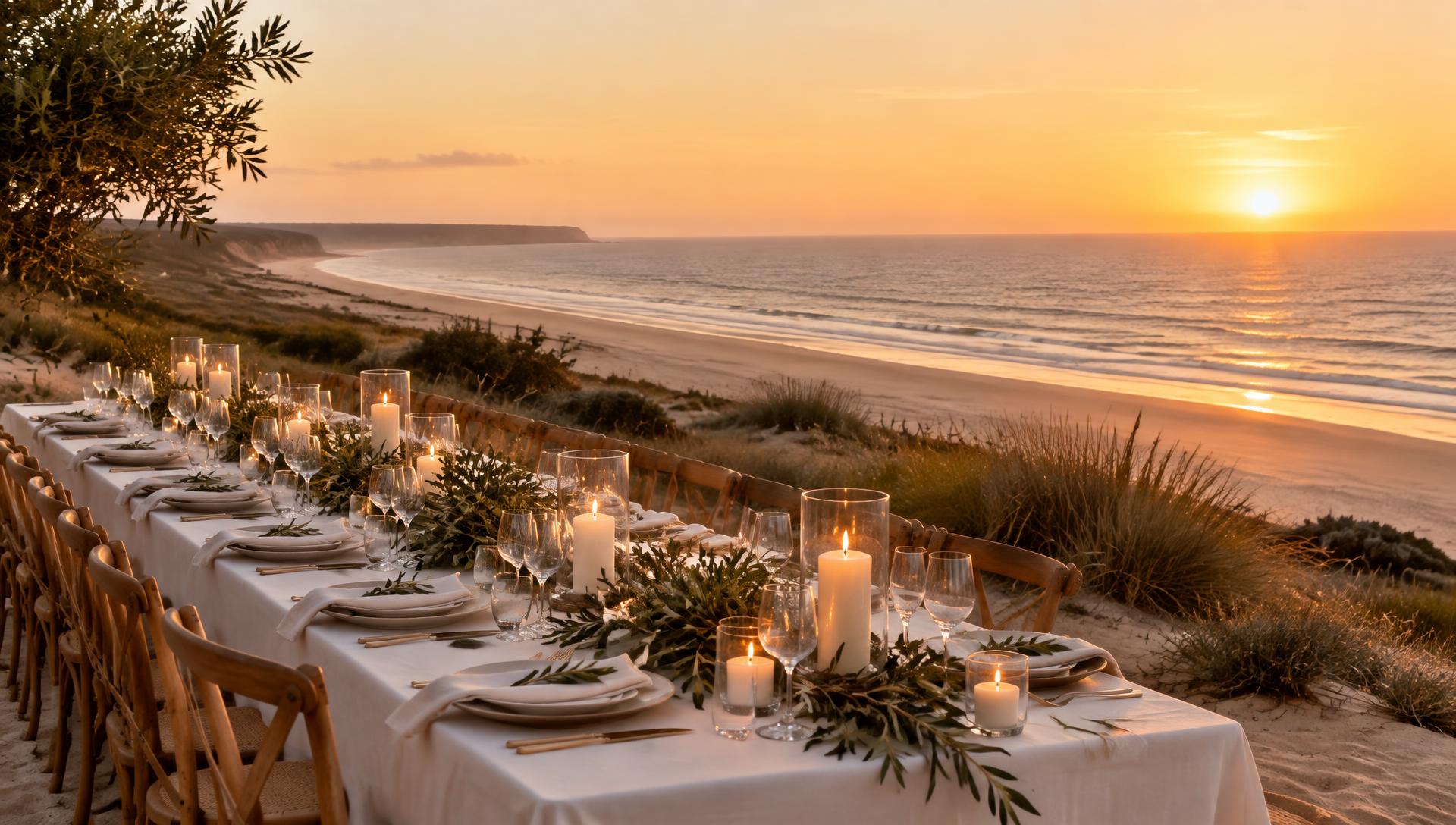
When couples imagine a beach wedding in Spain, they usually picture the Mediterranean: Marbella, yachts, a polished resort. The province of Cádiz offers something different. Its Atlantic shore, the Costa de la Luz, is a coast of long pale beaches, pine woods running down to the sand, fishing towns and white villages on the hills behind.
This guide explains what a Cádiz beach wedding is really like: where to celebrate, how to plan around the wind, which months work best and how to bring your guests there.
Why the Costa de la Luz
The name means "Coast of Light", and anyone who has watched the sun go down over the Atlantic from Cádiz understands why. Facing west and south, these beaches catch the evening light in a way the Mediterranean coast does not, which makes the hour before sunset an obvious moment for a ceremony.
The province also gathers several Andalusias in one place:
- The city of Cádiz. Often described as one of the oldest cities in Western Europe, it sits almost entirely surrounded by the sea, with a lived-in old town, its own beaches and a famous light.
- The white towns. Vejer de la Frontera, on its hill above the coast, is the best known: whitewashed lanes, small squares and views to the ocean and, on clear days, towards Africa.
- The beaches. From Conil to Zahara de los Atunes and Bolonia, the shore is wide, open and, for long stretches, largely unbuilt.
- Sherry country. Jerez, El Puerto de Santa María and Sanlúcar de Barrameda, the three towns of sherry, are a short drive inland or along the bay. Our Jerez wedding guide explores that side of the province.
Weighing the two coasts? Our Marbella wedding guide describes the Costa del Sol: glamour and infrastructure, where the Costa de la Luz offers space, nature and a quieter luxury.
Where to celebrate
On the beach itself
A barefoot ceremony on the sand can be done well, with two practical points in mind.
First, beaches in Spain are public land. A ceremony on the sand generally needs authorisation, usually from the town hall and in some cases from the coastal authorities, and the conditions vary from one municipality to the next. Allow time for this and expect rules on set-up, sound and access.
Second, many couples find the best solution is a setting that sits right on the beach rather than on it: a beach club, a hotel with direct access to the sand, or a private estate in the dunes. You keep the view and the sound of the waves, with a level floor, a kitchen and shelter if the weather turns.
A white town on the hill
Vejer and the villages of the interior suit couples who love atmosphere. Picture drinks on a terrace as the coast turns gold below you, then dinner in a courtyard or a boutique hotel. Old towns are compact, so these settings tend to suit smaller guest lists, and access for suppliers and guest drop-off need to be planned with care.
A country estate between sea and hills
Behind the coast lie cattle farms, cork-oak woods and cortijos, the traditional country houses of Andalusia. An estate offers privacy, room for a larger guest list and a party that can carry on late, often within a short drive of the beach. As with any rural venue, plan shuttles, power, lighting and a covered alternative. Our guide to hacienda weddings near Seville explains how these estates work.
| Beach club or beachfront hotel | White town | Country estate | |
|---|---|---|---|
| Atmosphere | Sand, sunset, ocean | Intimate, historic, views | Open skies, privacy |
| Best for | Small to medium weddings | Smaller weddings | Medium to larger weddings |
| Guest experience | Easy, relaxed | Walkable, charming | Secluded, needs transport |
| Key checks | Wind shelter, permits for the sand | Access, music limits | Transport, power, weather plan |
The levante: planning around the wind
No honest guide to a Cádiz wedding can skip the wind. The province sits beside the Strait of Gibraltar, where two winds take turns: the poniente from the west, usually fresher and gentler, and the levante from the east, which is warm, dry and can blow hard, particularly around Tarifa and the Strait. It can lift sand, topple flowers and carry a speech out to sea.
This is not a reason to avoid the coast, but it is a reason to plan for it:
- Choose a setting with shelter. A courtyard, a walled garden, a pine wood or the lee of a building turns a windy evening into a pleasant one.
- Keep a second layout ready. Decide in advance where the ceremony and dinner move to if the levante blows, and confirm it with the venue in writing.
- Design with the wind in mind. Low, weighted centrepieces, hurricane lamps instead of open candles, and fabrics that will not fly.
When to marry in Cádiz
The Atlantic keeps Cádiz mild. Summers are warm rather than scorching, unlike inland Seville or Córdoba, and winters are gentle. The figures below are AEMET's official long-term averages for the Cádiz weather station (climate normals 1981–2010), converted to Fahrenheit. They are averages, not forecasts.
| Month | Average high | Average low | Rainy days |
|---|---|---|---|
| March | 66°F | 54°F | 5 |
| April | 68°F | 57°F | 6 |
| May | 72°F | 61°F | 3 |
| June | 78°F | 67°F | 1 |
| July | 82°F | 71°F | under 1 |
| August | 82°F | 72°F | under 1 |
| September | 79°F | 69°F | 2–3 |
| October | 74°F | 63°F | 6 |
| November | 67°F | 56°F | 7 |
Rainy days are days with at least 1 mm of rain. Source: AEMET, Cádiz station, climate normals 1981–2010.
What this means in practice:
- May and June. Warm days, long evenings and the coast before the summer crowds. A lovely window for a beach wedding.
- July and August. Comfortable by Andalusian standards, but this is the height of the Spanish holiday season. Beach towns are busy and accommodation books early.
- September. For many couples, the sweet spot: the sea is at its warmest, the evenings are soft and the crowds thin out after the first weeks.
- October. Still mild and often bright, with more chance of rain as the month goes on.
- November to April. Gentle temperatures, but more rain and shorter days. Better suited to intimate celebrations indoors or in a sheltered courtyard.
Our guide to the best time to get married in Andalusia compares the coast with Seville and Granada month by month.
Two local events are worth knowing about. Cádiz Carnival, one of the best known in Spain, takes over the city for days, usually in February. And Sanlúcar de Barrameda holds its historic horse races on the beach in August. Both are wonderful for guests and both fill hotels, so check the dates for your year before choosing a weekend.
Getting your guests to Cádiz
There are no direct flights from the US to the province, but the routes are simple:
- Through Madrid by train. Direct Renfe Alvia trains link Madrid with Cádiz. Timetables change, so guests should check current services close to their travel dates.
- Through Seville. Seville airport has wide European connections and is roughly an hour and a half from Cádiz by road, which makes it easy to add a few days in the city.
- Through Jerez or Málaga. Jerez has its own small airport with mainly domestic and European flights; Málaga, on the Mediterranean, offers more connections but a longer drive.
Coordinated transfers and shuttles keep things simple when guests are spread across beach towns. Our guide to attending a wedding in Spain is a useful read to send them.
Shaping a Cádiz wedding weekend
- A welcome evening. Fried fish and cold manzanilla on a terrace above the sea, or tapas in Vejer as the lights come on.
- The wedding day. A ceremony timed for the golden hour, a cocktail hour facing the ocean, dinner under the stars and dancing late.
- A slow farewell. A long lunch by the beach, a morning walk at Bolonia, or a visit to a sherry bodega on the way to the airport.
How we help
We plan the whole weekend around the coast: a setting with the right shelter and a second plan for the wind, a date that works with the season and the local calendar, guest travel and transport, and a welcome evening and farewell that feel true to the Costa de la Luz. Explore a first selection of settings on our venues page, see everything we do on our services page, or read why couples choose Andalusia.
Still deciding between the Atlantic, the Mediterranean and the great inland cities? Our short wedding quiz gives you a first sense of setting, style and guest count. And when Cádiz feels right, begin your enquiry; we reply personally.
Frequently asked questions
Can you get married on the beach in Cádiz?
Yes, but beaches in Spain are public land, so a ceremony on the sand generally needs authorisation, usually from the town hall and sometimes from the coastal authorities. Rules vary by municipality. Many couples choose a beach club, beachfront hotel or estate in the dunes instead, keeping the view with more comfort and shelter.
What is the levante wind, and will it affect our wedding?
The levante is a warm, dry easterly wind that can blow strongly on the Cádiz coast, especially around Tarifa and the Strait of Gibraltar. It does not blow every day, but it should be planned for: choose a venue with shelter, agree a backup layout in advance and design décor that can cope with wind.
What is the best month for a beach wedding in Cádiz?
May, June and September are usually the most comfortable. Average highs at the Cádiz weather station range from about 72°F in May to 79°F in September, with very little rain. July and August are warm and dry but are the busiest holiday months on the coast.
How do guests get to Cádiz from the US?
Most fly to Madrid and take a direct train to Cádiz, or fly into Seville via a European hub and continue by road, roughly an hour and a half.