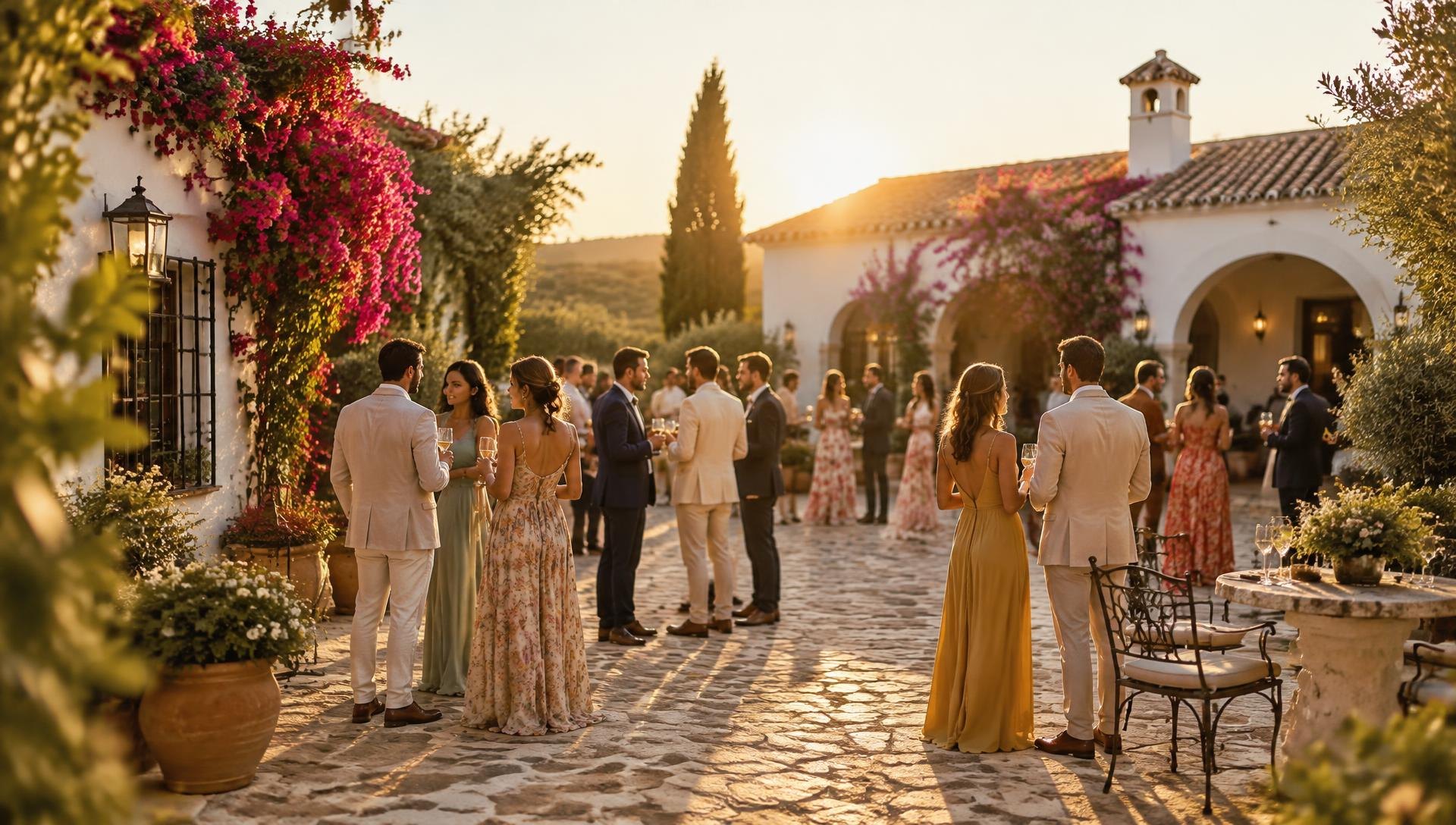
An invitation to a wedding in Spain is a lovely thing to receive, and a slightly puzzling one. What time does it really start? Is it acceptable to wear a short dress to an evening ceremony? Will there be a registry, and do I need any paperwork to fly in? Most American guests have the same handful of questions, and the answers are rarely in the invitation.
This guide is written for them, and for couples who would like to send their guests something calm and useful to read before they book their flights. It covers the rhythm of the day, what to wear, gifts, travel documents and the small customs that make a wedding in Andalusia feel different from one at home.
The rhythm of the day
The first surprise for most guests is the clock. Spanish weddings begin later and end much later than American ones, and the day unfolds slowly rather than to a tight schedule.
- The ceremony is usually held in the afternoon or, in the warmer months, in the early evening, once the heat begins to soften.
- The cocktail hour is long and generous, often with plenty of food. Do not mistake it for a light reception before the meal; it is part of the celebration in its own right.
- Dinner tends to start later than Americans expect and lasts a good while, with several courses and much conversation.
- The dancing follows dinner and can carry on well past midnight, sometimes with a second round of food in the early hours.
The practical advice is simple: eat a proper lunch, take a rest in the afternoon if you can, and do not plan an early flight for the next morning. If you would like to know more about the customs you may see along the way, from the thirteen coins to the hora loca, our guide to Spanish wedding traditions explains them.
What to wear
Dress codes vary from wedding to wedding, so the invitation or the couple's website should always come first. Within that, a few Spanish conventions are worth knowing.
For women
- Avoid white and ivory. As in the US, white belongs to the bride.
- Day and evening are different. Shorter cocktail dresses suit daytime and early-evening ceremonies; long dresses are often seen at formal evening weddings. When in doubt, a midi length is a graceful middle ground.
- Think about the ground. Andalusian weddings often take place in gardens, olive groves, gravel courtyards and old towns paved with cobblestones. Block heels, wedges or elegant flats will serve you far better than stilettos.
- Bring a layer. Inland evenings can cool noticeably after a hot day, especially in spring and autumn. A light shawl or wrap is useful and easy to carry.
- A fan is never out of place. In Andalusia it is as much an accessory as a practical tool.
For men
- A suit is the usual choice, even in summer. Lightweight fabrics such as linen blends or fine wool, in lighter colours for daytime, are both comfortable and correct.
- Ties are common at more formal weddings. If the dress code is relaxed, the invitation will usually say so.
- Shoes matter here too. Leather soles can be slippery on old stone, and grass is unkind to smart shoes. Comfort will matter at one in the morning.
| Situation | Women | Men |
|---|---|---|
| Daytime or early-evening ceremony | Cocktail or midi dress, comfortable heels | Light suit, tie optional unless formal |
| Formal evening wedding | Long or elegant midi dress, wrap for later | Darker suit and tie |
| Countryside estate or garden | Block heels or wedges, light layer | Suit in breathable fabric, sensible soles |
| Church ceremony | Shoulders covered inside the church is a respectful choice | Jacket on inside the church |
Gifts
In Spain it is common for guests to give money rather than choose from a registry, often by bank transfer to an account the couple shares. American couples marrying in Andalusia usually follow their own customs: a registry, a honeymoon fund or a simple note that guests' presence is gift enough.
The best guide is whatever the couple suggests. If nothing is mentioned, there is no need to carry a wrapped present across the Atlantic; a card and a gift sent to the couple at home is perfectly gracious.
Travel documents
The rules for entering Spain are set by the Schengen area, of which Spain is a member, and they do change, so treat this section as a starting point and check the official sources before you travel.
- Passport validity. The US State Department advises that your passport should be valid for at least three months beyond your planned date of departure from the Schengen area, and recommends six months.
- No visa for short stays. US citizens can currently visit Spain for tourism for up to 90 days without a visa.
- The Entry/Exit System. The EU has introduced a digital border system that registers travellers' faces and fingerprints in place of passport stamps. Expect this the first time you cross a Schengen border.
- ETIAS. You may have read about ETIAS, a travel authorisation for visa-exempt visitors such as Americans. As of November 2026 it is not yet in operation and has no confirmed start date. When it launches, apply only through the official EU website and be wary of third-party sites that charge for it.
Travel rules are not our area of expertise and change over time, so please confirm the current requirements with the US State Department and the official EU travel website before booking.
Getting there and getting around
Most American guests reach Andalusia through Madrid, then continue by high-speed train or a short domestic flight, or fly into Málaga or Seville via another European hub. Which route is best depends entirely on where the wedding is. Our guides to weddings in Marbella and weddings in Jerez cover the nearest airports for the coast and for Cádiz.
A few things make the trip easier:
- Arrive a day or two early. Jet lag and a late Spanish evening are a demanding combination. A buffer day lets you enjoy the welcome party rather than survive it.
- Use the arranged transport. Many Andalusian venues are in the countryside, and wedding-day shuttles are there precisely so that nobody has to drive or find a taxi at two in the morning.
- Pack an adaptor. Spain uses the European two-pin plug and 230-volt current.
- Mind the sun. Even in spring and autumn, the Andalusian sun is strong. Sunglasses, sunscreen and water are worth having during an outdoor ceremony.
Small customs worth knowing
- Greetings. Friends and family usually greet each other with a kiss on each cheek. A handshake is always fine if you are more comfortable with it.
- Toasts and speeches. Spanish weddings tend to have fewer formal speeches than American ones. Do not be surprised if the music and the conversation do most of the talking.
- Detalles. Guests are often given a small gift, or detalle, during the reception, sometimes handed out by the couple themselves.
- Sevillanas. If the band plays the region's folk music, someone will almost certainly pull you onto the floor. Say yes; nobody expects you to know the steps.
- Pacing. Wine and sherry flow generously and the night is long. Spaniards tend to drink steadily alongside food rather than quickly.
Making a trip of it
Many guests treat an Andalusian wedding as the centre of a longer journey: a few days in Seville or Granada before, the coast or the white villages after. Choosing the right season helps a great deal, and our guide to the best time to get married in Andalusia gives a month-by-month view that is just as useful for guests planning a holiday around the date.
For couples: helping your guests feel at home
If you are planning a wedding in Andalusia, a short, warm note to guests about timings, dress, travel and transport removes most of their uncertainty before it begins. We help couples shape the whole weekend around their guests, from airport transfers and shuttles to a welcome evening that introduces them to the region. See what we do on our services page, how a wedding comes together on our process page, or read why couples choose Andalusia.
Still deciding on the setting? Our short wedding quiz gives you a first sense of region, style and guest count. And when you are ready, begin your enquiry; we reply personally.
Frequently asked questions
What should I wear to a wedding in Spain?
Follow the dress code on the invitation first. In general, avoid white, choose a cocktail or midi dress for daytime ceremonies and a long or elegant dress for formal evening weddings, or a lightweight suit for men. Comfortable shoes for gravel, grass and cobblestones and a light layer for the evening are both wise.
What time do Spanish weddings start and finish?
Ceremonies are usually held in the afternoon or early evening, followed by a long cocktail hour, a late dinner and dancing that often continues well past midnight. Guests should plan for a long night and avoid early travel the next morning.
Do you give a gift at a wedding in Spain?
Yes. Spanish guests commonly give money, often by bank transfer, rather than choosing from a registry. At international weddings it is best to follow whatever the couple suggests, whether a registry, a honeymoon fund or no gift at all.
Do Americans need a visa or ETIAS to attend a wedding in Spain?
US citizens can currently visit Spain for up to 90 days for tourism without a visa, with a passport valid for at least three months beyond their departure date. As of November 2026, ETIAS is not yet in operation. Rules change, so confirm with official US and EU sources before travelling.
Is it rude to leave a Spanish wedding early?
Not at all. The celebration often runs into the early hours, and guests leave at different times. Thank the couple before you go, and take advantage of any arranged shuttle back to your hotel.