Most American couples who marry in Andalusia are not Spanish, and nobody expects them to be. Yet almost every couple we meet asks the same question at some point: which local customs could we borrow without it feeling like a costume? It is a good instinct. A wedding in Spain is more memorable when a little of Spain finds its way into the day, chosen with care rather than piled on.
This guide walks through the Spanish wedding traditions you are most likely to hear about, what each one means, and how gracefully it can sit within an international celebration in Southern Spain.
How a Spanish wedding feels different
Before the individual customs, it helps to understand the rhythm. A Spanish wedding is less a sequence of set pieces and more a long, generous evening.
- The day runs late. Ceremonies are often held in the afternoon or, in the warmer months, as the heat begins to soften. Dinner follows a long cocktail hour, and the dancing that comes after can carry on well past midnight. Weddings in Spain traditionally end very late.
- The table matters most. Food and conversation are the heart of the day. Guests expect to sit, eat well and stay a while.
- The guest list is wide. Family in its broadest sense, from great-aunts to childhood neighbours, is part of the celebration.
For American guests this pace is often the biggest surprise, and usually the part they remember most fondly. If you would like to see how it shapes a full weekend, our process page explains how we plan the days around it.
Ceremony traditions
Los padrinos
Spanish weddings traditionally have no bridesmaids or groomsmen. Instead, the couple is accompanied by the padrinos: classically the groom's mother, who walks him to the altar as madrina, and the bride's father, who walks her in as padrino. They often sign as witnesses, too.
For an international couple, the idea translates beautifully. You can keep your wedding party and still give two people you love the role of padrinos, or simply ask a parent on each side to walk you in, in the Spanish way.
Las arras
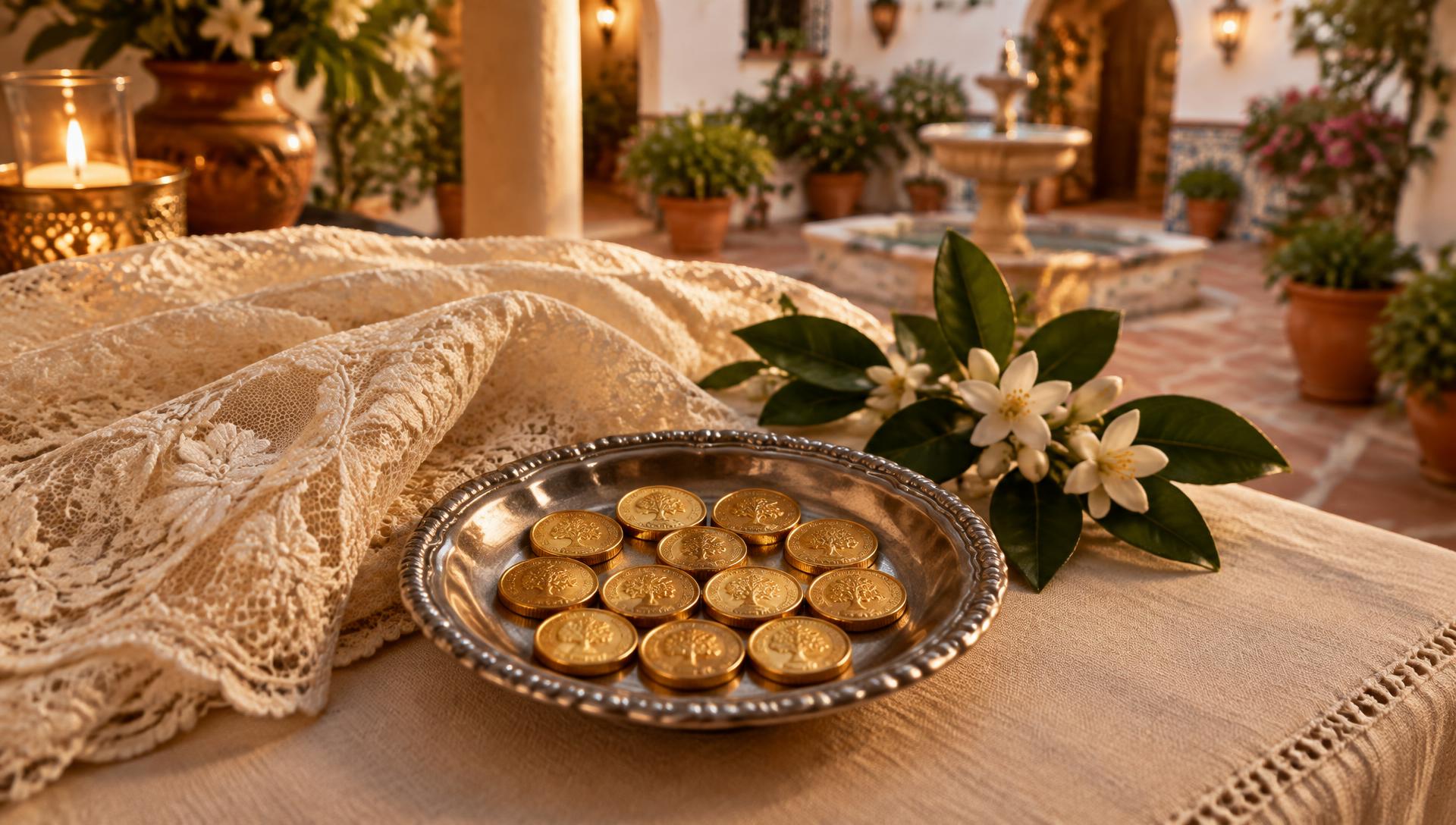
The arras are thirteen coins that pass between the couple during the ceremony, a symbol of the promise to share everything they have and will have. They are usually presented in a small box or dish and often kept afterwards as an heirloom.
It is one of the most popular traditions to borrow, because it is short, visual and easy to explain in a line of the ceremony script. It works as well in a symbolic ceremony in an olive grove as it does in a church.
The mantilla
The mantilla is a long lace veil, sometimes worn over a high comb called a peineta. Many Spanish brides wear one passed down through the family, and it remains closely associated with Andalusia, where it is still seen at weddings and during Holy Week.
A mantilla is a quietly elegant choice if you would like a nod to Spain in what you wear, whether it is an heirloom from home or a piece of lace found in Seville.
Orange blossom and rings
Orange blossom, azahar, has long been part of Spanish bridal flowers, a fitting choice in a region where orange trees line the streets of Seville. Traditionally, Spanish couples also wear their wedding ring on the right hand rather than the left. Some international couples enjoy that detail; most keep their rings on the left. Either is entirely yours to decide.
Reception traditions
Los detalles
Detalles are small gifts for guests, handed out during the reception, often by the couple themselves as they move from table to table. It is a lovely excuse to greet everyone in person. In Andalusia, natural choices include local olive oil, a fan for summer evenings or a bottle of sherry from Jerez. We often fold this idea into guest welcome bags, so the thank-you arrives the moment guests check in.
The tie and garter
At some traditional Spanish weddings, the groom's friends cut his tie into pieces and sell them to guests, with the money going to the couple; the bride's friends sometimes did the same with her garter. The custom is becoming less common, and it depends on the crowd. With a mixed group of American and European guests, it can be a playful moment or simply a curiosity to mention in the toasts.
Sevillanas and flamenco
In Andalusia, there is a good chance someone will start dancing sevillanas, the folk dance of the region's fairs and pilgrimages, once the music turns local. It is danced in pairs, in short sequences, and Andalusian guests tend to pull everyone else onto the floor. A short performance by flamenco musicians or dancers during the cocktail hour, or a guitar trio at the welcome evening, gives international guests a feel for the music before the party begins.
The hora loca
The hora loca, or "crazy hour", is a newer custom that has become a fixture at many Spanish weddings. Late in the night, the music lifts, dancers or performers arrive and guests are handed props, masks, glow sticks and noisemakers. It is a burst of energy just when a long evening might otherwise begin to fade, and American guests usually love it.
The late-night bite
Because dinner is long and the dancing longer, many Spanish weddings bring out food again in the early hours, from small sandwiches to something warm. A late-night snack is a small, generous gesture, and a very practical one when guests are still dancing at two in the morning.
Which traditions to borrow: a quick guide
| Tradition | What it is | Where it fits | Effort to include |
|---|---|---|---|
| Padrinos | Two loved ones accompany the couple | Ceremony entrance | Very easy |
| Arras | Thirteen coins exchanged as a promise | Ceremony script | Very easy |
| Mantilla | Long lace veil, often an heirloom | Bridal look | Easy |
| Orange blossom | Traditional bridal flower | Bouquet, buttonholes, décor | Easy, seasonal |
| Detalles | Small gifts handed to guests | Reception or welcome bags | Easy |
| Sevillanas and flamenco | Andalusian music and dance | Welcome evening, cocktail hour | Moderate |
| Hora loca | High-energy party moment | After midnight | Moderate |
| Tie and garter sale | Friends raise money for the couple | Late reception | Depends on the crowd |
Bringing traditions in without overdoing it
The most graceful weddings we see choose two or three customs and let them carry meaning, rather than ticking off a list. A few gentle principles help:
- Explain, briefly. One line in the ceremony or the order of service lets guests understand what they are watching. Meaning travels further than spectacle.
- Match the setting. An arras exchange feels natural in a hacienda chapel or a palace garden; a hora loca belongs to a venue where the party can run late.
- Mix in your own. A first dance, a toast from your best friend or a family tradition from home sit perfectly well alongside Spanish ones. The blend is often the most personal part of the day.
- Think about the whole weekend. Some traditions shine more at the edges: flamenco at a tapas welcome party, sherry at the farewell brunch.
If you are still choosing a region, our guides to hacienda weddings near Seville and weddings in Jerez show how local character shapes the day. And if you are wondering what is legally possible for the ceremony itself, read our guide to getting legally married in Spain as an American couple.
How we help
We help each couple decide which traditions feel right for them, then weave them into the ceremony script, the design and the timeline, so they feel natural rather than staged. Explore our services, see the settings we work with on our venues page, or read why couples choose Andalusia.
Not sure yet what style of wedding you are dreaming of? Our short wedding quiz gives you a first sense of setting, atmosphere and guest count. And when you are ready, begin your enquiry; we reply personally.
Frequently asked questions
What are the most common Spanish wedding traditions?
The best-known are the padrinos, who accompany the couple instead of a wedding party; the arras, thirteen coins exchanged during the ceremony; the lace mantilla veil; detalles, small gifts for guests; and, at many modern weddings, the hora loca, a high-energy party moment late in the night.
What do the 13 coins mean at a Spanish wedding?
The thirteen coins, called arras, symbolise the couple's promise to share everything they have and will have together. They are exchanged during the ceremony, usually presented in a small box or dish, and are often kept afterwards as an heirloom.
Can we include Spanish traditions in a symbolic ceremony?
Yes. Because a symbolic ceremony has no legal script, you are free to include customs such as the arras or the padrinos' entrance, and to explain them to your guests in your own words.
What time do Spanish weddings usually finish?
Spanish weddings traditionally finish very late. After a long cocktail hour and dinner, the dancing often continues well past midnight, and the exact end time depends on the venue's rules and any local restrictions on music.
What is the hora loca at a Spanish wedding?
The hora loca, or "crazy hour", is a burst of high-energy music late in the evening, usually with performers and props such as masks, glow sticks and noisemakers handed out to guests to keep the party going.