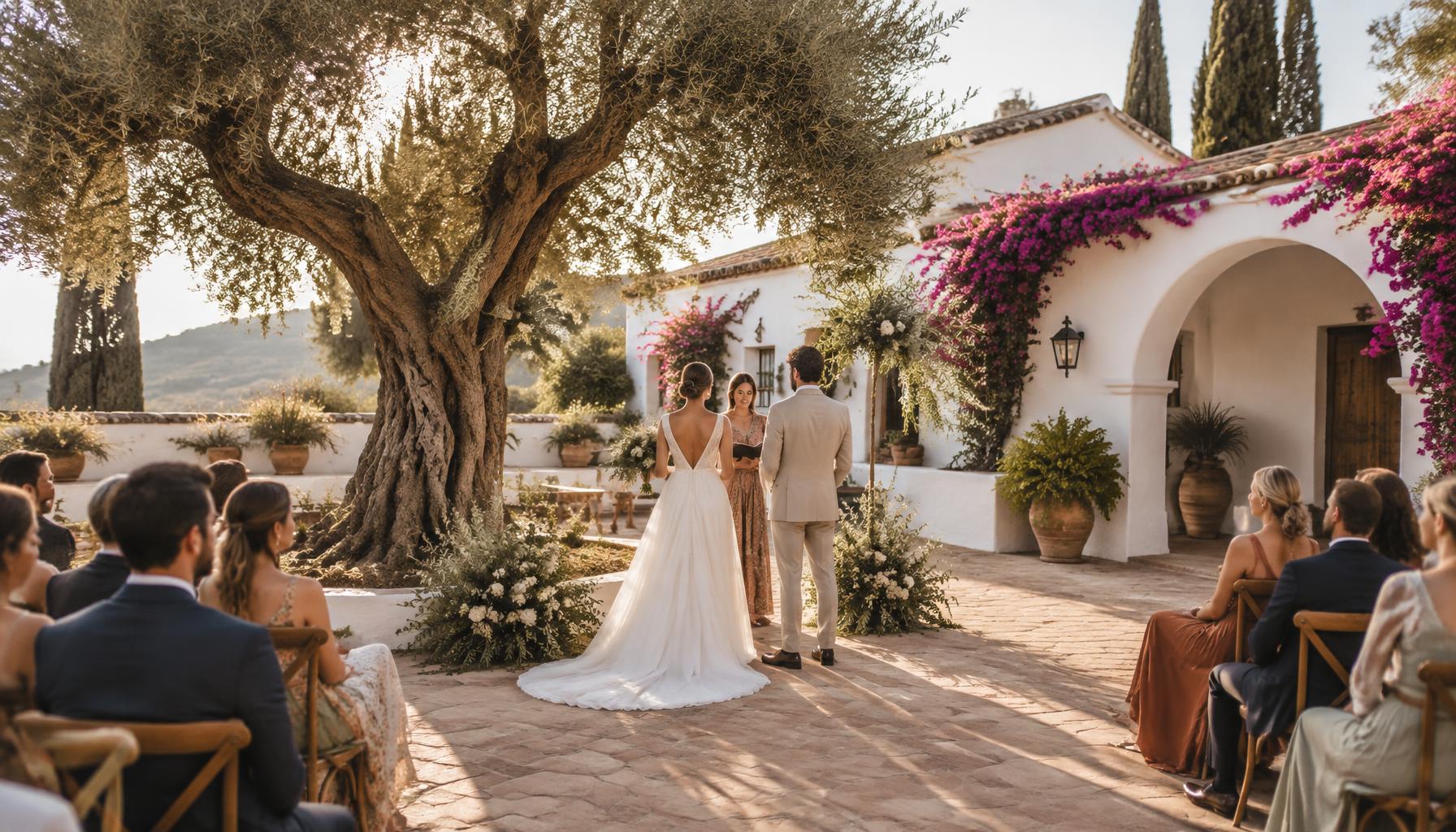
It is usually the first question we are asked, often before venues, flowers or dates: can we actually get married in Spain? The honest answer is yes, you can have your wedding here, but whether the marriage itself is signed in Spain depends on which of three routes you take. Understanding them early will shape your timeline, your paperwork and, quite often, the kind of ceremony you end up loving most.
This guide is written for couples who are both US citizens living in the United States. It is not legal advice, and rules can change, so always confirm the details with your county clerk, the US Embassy in Madrid and the Spanish registry or parish involved. But it will give you a clear map of the territory.
The short answer
Spain does not make it easy for two non-residents to marry in a civil ceremony. A Spanish civil wedding generally requires at least one partner to have been legally resident in Spain, typically for the two years before the wedding. For most American couples that rules out the civil route.
That leaves three realistic paths:
- Marry legally at home, then celebrate with a symbolic ceremony in Spain. This is what the large majority of international couples choose.
- A Catholic church wedding in Spain, which can carry civil validity without the residency requirement, provided both partners meet the Church's requirements.
- A Spanish civil wedding, realistic only if one of you lives in Spain or is planning to.
Option 1: Sign at home, celebrate in Andalusia
This is the route we recommend to most couples, and not only because it is simpler.
You complete the legal formalities in the United States — usually a short appointment at a county clerk's office or courthouse, a few days or weeks before you fly. Then, in Spain, you hold the ceremony your guests travel for: under an olive tree, in the courtyard of a hacienda, on a terrace above the Mediterranean as the light turns gold.
Why couples love it
- Total freedom of setting. Because the ceremony carries no legal paperwork, it can happen almost anywhere: a private garden, a vineyard, a cliff-top village, a palace patio.
- Total freedom of words. A symbolic ceremony is led by a celebrant, in English or bilingual, and written around you: your story, your readings, your family traditions.
- No translations, no apostilles, no interviews in Spanish. The legal side stays in your own language and your own legal system.
- No risk to your date. A Spanish file that is delayed by a missing document can put a wedding date at risk. Signing at home removes that uncertainty entirely.
Practical notes on the US side
Marriage license rules are set by each state, and sometimes each county. Before you book your courthouse appointment, check:
- how long the license is valid after it is issued;
- whether there is a waiting period between applying and marrying;
- whether witnesses are required, and how many;
- how long it takes to receive your certified marriage certificate.
Many couples keep the legal signing quiet and intimate — just the two of them, or with parents — so that the day in Spain still feels like the wedding. To your guests, a beautifully written symbolic ceremony is indistinguishable from a legal one.
Option 2: A Catholic wedding in Spain
If faith is central to your marriage, a Catholic wedding in one of Andalusia's churches is possible for non-residents, and in Spain a canonical marriage can have civil effect once it is registered with the Spanish Civil Registry.
The process runs through the Church rather than the town hall, and it takes time:
- Start with your home parish in the US. Your priest prepares the marriage file, often called the pre-nuptial file, including baptismal certificates and confirmation that you are free to marry.
- Marriage preparation. Most dioceses require a pre-Cana or equivalent course.
- Transfer to Spain. Your home diocese sends the file to the diocese in Spain where you will marry, and the Spanish parish confirms the date and priest.
- Registration afterwards. After the wedding, the marriage is registered with the Spanish Civil Registry, and you will want the Spanish certificate apostilled so it can be used back home.
Allow at least six to nine months for the paperwork alone, and remember that each diocese has its own requirements and calendar. Not every historic church accepts weddings for non-parishioners, and some limit the dates they offer, so this route also narrows your choice of setting.
Option 3: A Spanish civil wedding
If one of you is a Spanish resident — or will be, for long enough before the wedding — a civil marriage in Spain becomes possible. It is a thorough process:
- Proof of residence, usually through the local municipal register (empadronamiento).
- Long-form birth certificates, recently issued, with a Hague Apostille from the Secretary of State of the state that issued them.
- Proof that you are free to marry. Because the US does not issue a certificate of no impediment, this is usually a sworn statement made at the US Embassy in Madrid or the Consulate General in Barcelona.
- Divorce decrees or death certificates for any previous marriage, also apostilled.
- Sworn translations of every document into Spanish by a translator certified in Spain.
- A file and interviews at the Civil Registry or a notary, often with a separate interview for each partner.
Processing times vary from region to region and from one registry to the next, which is why we always advise couples on this route to begin many months ahead and to choose a wedding date with some breathing room.
Which route is right for you?
| Symbolic in Spain (legal at home) | Catholic in Spain | Civil in Spain | |
|---|---|---|---|
| Residency needed | No | No | Yes, usually 2 years for one partner |
| Paperwork in Spain | None | Through the Church | Extensive |
| Choice of setting | Almost anywhere | A consecrated church | Registry, town hall or notary, depending on the municipality |
| Ceremony language | English or bilingual | Usually Spanish or bilingual | Spanish, with interpreter if needed |
| Typical lead time | Weeks (US license) | 6–9+ months | Several months or more |
For most American couples, the first column is the clear choice. It keeps the legal part simple and gives the ceremony in Spain the freedom it deserves.
A suggested timeline
- 12–18 months before: choose your route, your region and your venue. The most sought-after haciendas in Andalusia book early for May, June and September.
- 9–12 months before: one planning visit to see venues, taste the menu and meet key suppliers (see how we work).
- 6–9 months before: for a Catholic wedding, open your file with your home parish.
- 2–3 months before: check your state's license rules and book your courthouse appointment for the legal signing.
- Wedding week: a welcome evening, the ceremony and celebration, and a slow farewell brunch the morning after.
How we help
Whichever route you choose, we coordinate the Spanish side: the venue and its permissions, an English-speaking celebrant who writes your ceremony with you, music and readings, and — for church weddings — liaison with the parish and diocese in Spain. You can see the full scope on our services page and explore the settings we work with on our venues page.
If you are still at the dreaming stage, our short wedding quiz gives you a first picture of style, guest count and budget. And when you are ready, begin your enquiry — we reply personally.
Frequently asked questions
Is a symbolic ceremony in Spain a "real" wedding?
Emotionally, absolutely: it is the ceremony your guests attend, with your vows, rings and families. Legally, your marriage is the one you signed at home. For guests there is no visible difference, and many couples prefer the freedom it gives.
Can two Americans have a civil wedding in Spain without living there?
Generally no. A Spanish civil wedding normally requires at least one partner to have been legally resident in Spain, typically for two years. Non-resident couples usually marry legally at home or, if eligible, choose a Catholic wedding.
Will a Catholic wedding in Spain be recognized in the US?
A canonical marriage registered with the Spanish Civil Registry is a legal marriage in Spain, and Spanish marriage certificates can be apostilled for use abroad. Check recognition and any registration steps with your state before the wedding.
How far in advance should we start?
For a symbolic ceremony, the legal step at home can be done a few weeks before you fly, but the venue should be booked 12–18 months ahead for peak season. For a Catholic or civil wedding in Spain, start the paperwork at least six to nine months ahead.
Do we need to speak Spanish?
Not for a symbolic ceremony, which can be entirely in English. A civil wedding in Spain is conducted in Spanish, with an interpreter if one of you does not speak it well; church weddings can often be bilingual if the priest agrees.
This article is general guidance for planning purposes and is not legal advice. Requirements vary by state, diocese and Spanish region and can change, so confirm the details with the relevant authorities before you book.